
Should Children See A Dead Person? - A Mindful Approach to Dementia & Psychedelics
When the darkness of the pre-dawn hours after the passing of my husband, Henry, opened to a most magnificent sky of dappled colors, my daughter said it was time to inform hospice. I am forever grateful my two daughters stopped me from calling hours prior. Even though hospice said we had as much time as we wanted (within reason, but even more than 24 hours), the perceptible sacredness of death went unbroken in those hours in which we were absorbed in blessedness.
When the kind hospice nurse came around 8:00 AM, she removed the catheter. Henry looked fresh and clean since he had recently been tended to, so he was left otherwise untouched. Seeing we were comfortable and wanted to remain in such a peaceful, gentle atmosphere, she left the bedroom quietly. In the other room, she made the phone call that handled the medical and legal aspects of death. She also informed the funeral home of the late afternoon time my daughters requested for the body to be taken.
The three of us alone again, sitting around my husband’s body, their dad, we began to think about all those things—THE THINGS. The “To Dos” of life. The first question they asked me was if they should have the children come. The grandchildren are ages 4 through 10. I felt an instantaneous physical reaction in my gut: my stomach contracted. Not a yes, but a culturally imposed negative reaction to this idea. With that awareness, I listened to my heart and remarked, “They are your children. You are the mothers. It is your decision to make, not mine.”
By mid-morning, the children arrived, tiptoeing into the bedroom. They had gained comfort in being with him during several visits, sitting near him or laying by his side as he slipped from communicating to the outer world and transitioned to an inner stillness. This time, now dead, he did not look that different from the last few days when he seemed to be in a deep, deep peace. In fact, my daughter and I remarked that he looked uncannily similar to some Indian saints we had seen upon their death. An ethereal peace exuded from him, as it did in deep meditation.
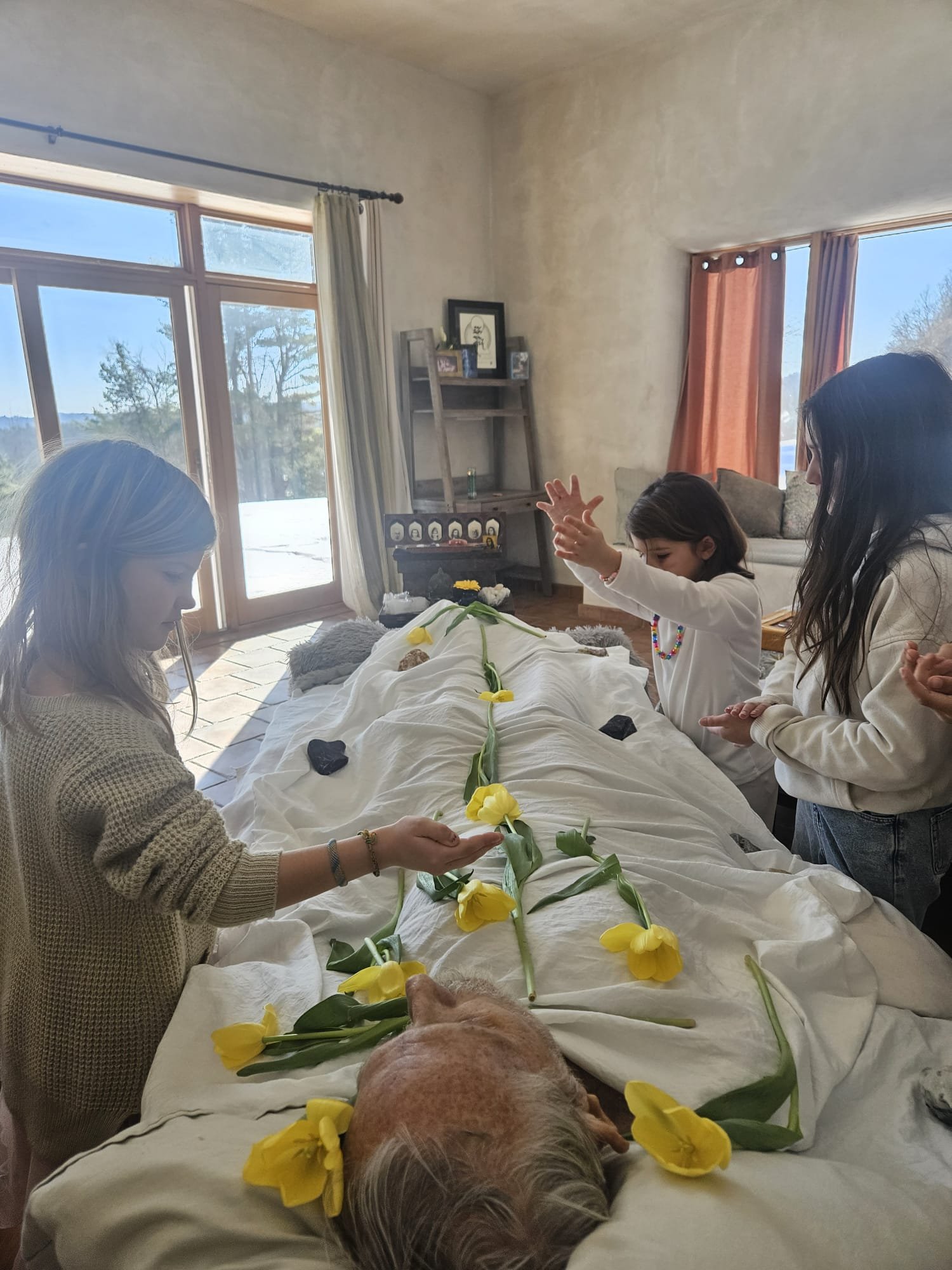
The children began to gently touch his body; or more accurately, they touched the sheet that draped all of his body except his head. Someone brought in the yellow tulips from a vase in the living room. The children had placed the tulips all along the sheet over his body. Then one of them decided to put some of the tulips in a heart shape around their grandfather’s heart. We had sandalwood talc powder and a spray bottle of rose water. The children proceeded to sprinkle the powder and spray the mist in a most loving and tender way.
I was mesmerized at what I was witnessing. These little angels tending to their dead grandfather as if it were the most natural thing on Earth. The beauty of and astonishment in this has moved me forever. And not just me, their parents—my daughters and sons-in-law—all of us, truly amazed.
When my sister-in-law came, we all left the bedroom to give her some time alone. What to do with five grandchildren? I immediately went to engaging them in a baking project to make a “Didda” cake—Didda being the name they called their grandfather. With his love of butter and olive oil, we attempted to make a cake with an abundance of both ingredients. My daughters had some time to be with their respective husbands while I lined up all the grandchildren on stools at the kitchen counter, each involved in a specific job for our Didda baking project.
Laughing and chatting as if just a normal day, as schemed together, was he. How could I have just come from one of the most sacred hours of my lifetime, just paces away, to find myself in the throes of measuring, stirring, and baking? Children bring you right down to Earth. They bring you directly into the Present Moment. And so the healing effect of their presentness brought levity, laughter, joy, and ever-deepening connection. The cake fell apart when it was cooling, eliciting even more laughter, and it didn’t taste as good as we thought, so we have a ways to go on our next attempt, but making Didda Cake will remain a wonderful memory for all.
It was not even noon, and we had the entire day ahead of us before the people from the funeral home were to come. And so the day proceeded with family moving in and out of the bedroom. The children, too, would go in on their own, as a trio, or all five together. They would sprinkle more powder or reposition a flower. At other times, we would see one or two of them sit on the nearby bed in meditation position, eyes closed in silence, as they had seen their grandfather do for hours on end since they were born. At one point, the youngest, four-year-old Nico, who looks most like his grandfather, quietly walked in and kissed his grandfather on the forehead. A photo captures this most precious moment.
A photo of the children standing around their grandfather with the tulips draped around his body was shared with the extended family. They, like us, our immediate family, have been transformed by this experience. As my sons-in-law have said, these kids will be comfortable with death. This experience, and the days that preceded it when they visited their grandfather in the quiet peacefulness of his final days at home in bed, tended to with love and grace, leave indelible imprints of how death can be. Not to be feared, but a natural, peaceful transition surrounded in love.
- Lauren Alderfer, PhD.