Henry’s Alzheimer’s Journey Has Ended - A Mindful Approach to Dementia & Psychedelics
My husband is dead. His primary care physician and his neurologist, whom he had seen three days before the last blog I wrote from the emergency room, both say it was due to the pharmaceutical medication he was taking for Alzheimer’s. Indeed, the rivastigmine patch landed Henry in the emergency room due to urinary retention, not a common side effect but a side effect nonetheless. That led to a UTI. Everything caused a level of pain and confusion that resulted in such an immediate decline that my husband was dead within two weeks of the ER visit. In medical jargon, the rivastigmine triggered a chain of events that led to death.
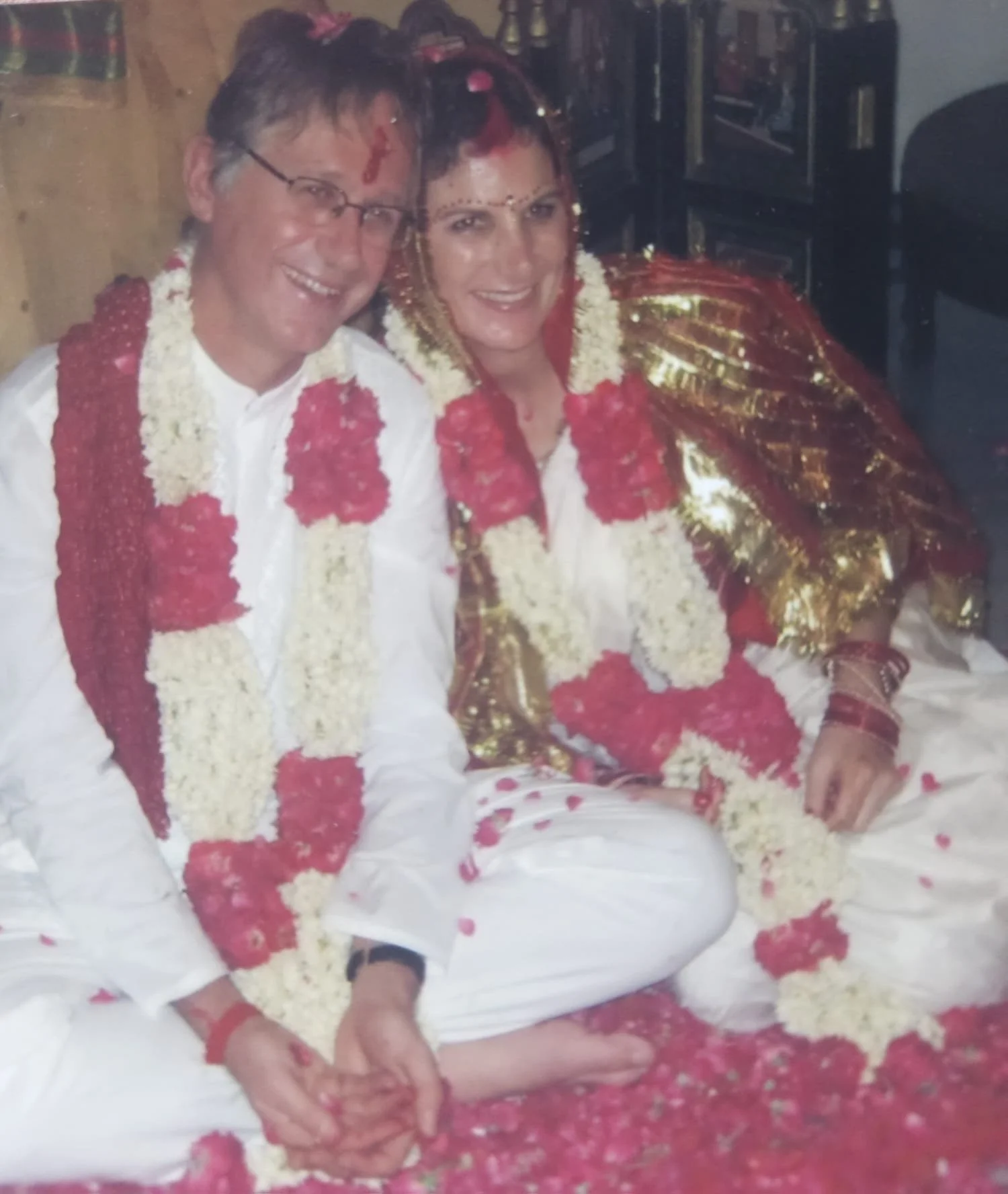
This is my first time writing since I reemerge from both a traumatizing week of witnessing someone endure agonizing pain and my husband’s final days, which were pain free and ultimately also medication free. In those last five days, Henry’s energy shifted to a softness, a tenderness, and a sweetness that exuded the essence of his being. I also believe there was a palpable force where he was catalyzing years of spiritual and contemplative practice, loving devotion, and will power to move to merge with the Infinite Source — some may call God, Moksha, Self-Realization, Liberation, Jesus Christ, the Infinite, Source. My two daughters and I held space for what came to be a most beautiful passing. All three of us know we were the ones who felt the blessings of being present.
In these days and hours leading to leaving the body, we tried to create and then protect a safe, loving presence around Henry. Then, in those most sacred hours after his passing, from the early hours past midnight until the break of dawn, an energy was held in deep awe, as if held in a sacred, holy safety net of our bubble. For me, it was an experience beyond anything I had ever known. I felt the essential nature of my husband’s being transmuted into me — a transmission within the Tibetan Buddhist culture is the closest thing I can reference. Or, for that matter, on a mushroom experience where I have felt the mushroom imprint its nature into me. I was not asleep, but I cannot claim I was in a fully wakeful state. I lay suspended within the two. During those hours, which held no time reference for me, two more waves of experience moved me in ways words cannot describe. What I do know is that it is a potentially sublime time for blessings, sacredness, transformation. I have forever been changed and know this blessed experience lives on in me. Death has a potential to change lives, not just the one who is leaving physical form.
My husband became my greatest teacher. Your energy matters. Who you have become — not in action and deed, though positive ones always support the essence of you we are in positive ways — but the energy that is you — call it the manifested form of your essential nature mixed with intentionality — even before thought, word, or deed, DOES MATTER. These are the imprints, known as samskaras or can be thought of as karmic imprints. Who we are becoming in and of itself is the point.
As I sit writing, almost two weeks to the day of Henry’s passing, I am surrounded by the morning sun, its orange glow through the sublime soft haze of the dawn, the mountains covered in dreamy mist. My abode is a sanctuary that feels blessed and imbibed with imprints from my husband’s angelic departure. I am the one truly blessed by a husband of forty-five years whose polestar was always the Infinite. His twice-daily meditation practice, japa yoga with his mala beads (hundreds of thousands of mantra repeated over the years) that brought the mind and heart together as one, his heart also aflame with love and devotion to that which is Greater. Even in his years with Alzheimer’s, these were the qualities and habits that remained. Abilities such as driving, making a meal, knowing how to dress, or places and sometimes names may have floated away — what is their importance when it comes to the spirit? Not much, especially at the end of life.
My high school friend, a sister to me, who came to help after Henry’s passing, said Alzheimer’s has made me a kinder person. “You have changed and softened so much,” she remarked. Not only have sharpness, edges, and reactivity melted away, but the heartbeat of loving kindness became — and is still now — the rhythm that moves me through my dreams, my way of being, the very nature of who I am. It certainly became the overriding intention of how I wanted to be with Henry, as his caregiver, wife, and spiritual companion.
Throughout the Alzheimer’s journey, our shared foundation of a mindful approach to all that unfolds opened our hearts in gratitude — he as someone with Alzheimer’s and me as caregiver. We understood the journey was meant to be — a lifetime that continually potentializes healing and wholeness.
Truly in the end, as Sri Daya Mata of Self-Realization Fellowship says and as is the title of her book, “Only Love.” Let kindness be your polestar. Managing the symptoms of a disease such as Alzheimer’s is not the same as showing kindness to the spirit of who the person is. We can always connect in kindness, in love. That is the energy that comes through. That is the energy that matters. That is the energy that will keep the person feeling safe. Feeling connected. Feeling supported. Feeling held in love.
The beginning years may be the most confusing, when you question the person you are in relationship with — doing strange and inexplicable things. These actions, in deed and/or word, erode trust, erode deep connection, erode foundations of partnerships and marriages. They can increase your own frustration, loneliness, exasperation, and may even cause the worst of you to come out in reactivity, anger, and even escape.
Why could I have not been kinder during this time? Once I knew it was dementia, and eventually diagnosed as Alzheimer’s, that is when I understood the behavior as symptoms. Kindness began to reign. Yet, I asked myself, “Why did I need a reason, a diagnosis, to be kind? Why could I have just been kind to be kind?”
In our case, there was enough of a strong foundation of commitment and understanding to navigate this difficult and confusing phase of Alzheimer’s — a phase that was close to a decade. Then all concerns were on Henry. It took a few years for him to be comfortable enough to tell our daughters and his siblings. This was the loneliest phase for me, as I respected his privacy in dealing with dementia. During this time, when I “kept the secret,” I would help finish sentences at dinner parties, or give excuses to others when something he did or said didn’t make sense. Then, at a certain point, living in this loneliness became too much for me to bear. Once I reached out and found support through my friendships, I began to breathe a little better. This was the beginning of understanding I was a caregiver, as I watched our marriage change. It was also the beginning of my understanding that a caregiver’s needs are 50% of the considerations in decision-making going forward.
And so my journey as a caregiver has come to its finality. A new phase in life awaits me. I am in this in-between place where I am still immersed in the quietude of a peaceful passing of my companion, soulmate, husband of 45 years, and the soft glow of the morning’s dawn. I am cocooned in this ever-so-tender place of being. I will emerge in good time, in my own time.
I aim to capture some of my contemplations, thoughts, and mindful inquiries I witnessed and experienced during Henry’s dying process. I’m as committed as ever to tell Henry’s complete story.
A big part of the story is how microdosing proved more valuable, in my husband’s case, than a pharmaceutical medicine for Alzheimer’s. Did he want his dying experience to become a compelling way to advocate for the safe and beneficial use of microdosing for dementia? One of his last legacies was collaborating with me just a few weeks ago on the Dementia Microdosing Protocol and Assessment. If inevitably facing advanced Alzheimer’s, end-of-life choices are important to consider. However, for someone with Alzheimer’s, there is no dignified way of making a choice for MAID in the United States. Did Henry somehow orchestrate the surprising ending that he ultimately had hoped for? …To die at home pain free, without medication, with as much cognition as possible?
How do free will and destiny interact? What is our relationship with death? How can we prepare for death? Can we hold space for the process? How can the dying process be likened to a high-dose psychedelic experience? How did two high-dose psychedelic experiences prepare Henry for the dying process? And how are those holding space for the dying similar to space holders in a high-dose journey? How do years of mindfulness practices prepare both the dying and those holding space? The last days of Henry’s sense of peace reminded me of the people at the assisted living in advanced stages of Alzheimer’s. Were they in a similar experience, just beyond our concept of time — in Henry’s case lasting a few short days, but in theirs it was years? How are rituals important during the dying process? What happens at death? Where does the person’s energy go? What transformations are possible? What blessings can come out of such an intense experience? What about hospice, death doulas, and the way we can hold space? And that of family members, including young children? Why did my husband have to endure agonizing pain? What about those that bore witness to that pain? How can that bring people into deeper connection and love?
In the days and weeks ahead, I will contemplate these queries and more. I will share lessons in dying and reflections after Henry’s passing. The story continues, at least a little bit longer, for I committed and agreed to be his voice of the journey we shared, melding mindfulness, dementia, and psychedelics.
For now, I will integrate and contemplate the intense experience shared with my daughters as we cocooned my husband in love and safety at home in Vermont. Our home, a beautiful straw bale house designed by our dear friend, a Tibetan architect, based on Vastu, is built on original Abenaki land trust ground. Similar to a Himalayan view on a cloudy day, peaks in the tri-state of Vermont, New Hampshire, and Massachusetts nestled Henry in their strength and safety in his actively dying process. Henry’s heart was always one with the natural world. The Infinite called Henry home. In those last days, when Henry no longer spoke, he embedded the following in me: “Always keep your heart pointed to the Infinite.”
- Lauren Alderfer, PhD.